
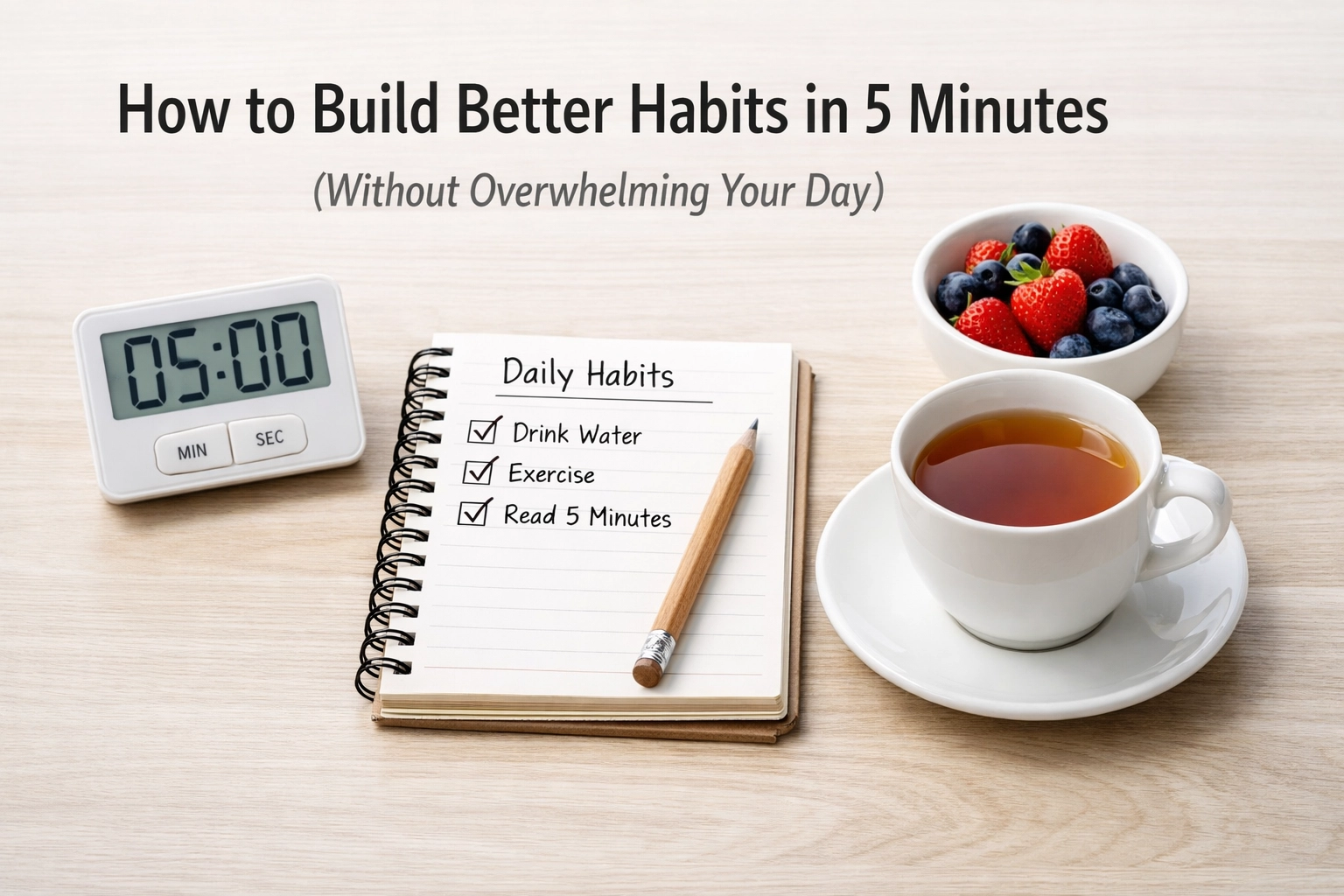
Most people abandon their new habits within the first two weeks. The reason isn’t a lack of motivation or willpower: it’s that the habit feels too big, too demanding, and too disruptive to an already packed schedule. When building better habits requires a complete lifestyle overhaul, the odds of success plummet.
The solution lies in a counterintuitive approach: make habits so small they seem almost trivial. Five minutes is enough time to start building meaningful change without triggering the resistance that derails most attempts at self-improvement.
Why Five Minutes Actually Works
The human brain is wired to resist change. When faced with a significant new demand: like “exercise for an hour every day” or “read for 30 minutes before bed”: the mind immediately calculates the cost: time, energy, disruption to existing routines. This psychological friction creates resistance before the first attempt even begins.
Five minutes bypasses this resistance mechanism entirely. The commitment is so small that the brain doesn’t perceive it as a threat. There’s no need to rearrange schedules, wake up earlier, or sacrifice other activities. The barrier to entry drops to nearly zero.

Once someone commits to just five minutes and actually starts the activity, something remarkable happens. The hardest part: initiating the behavior: is already complete. Most people discover they naturally continue beyond the initial five minutes because the momentum has already built. Even if they stop at exactly five minutes, consistent daily practice still creates neural pathways that make the behavior feel more natural over time.
Research in behavioral psychology supports this approach. Small, consistent actions repeated daily create stronger habit formation than sporadic bursts of intense effort. The brain responds to frequency and consistency, not duration. Five minutes every single day builds a more robust habit than 35 minutes once a week.
The Microhabit Foundation
Microhabits are actions so simple and quick that failure becomes nearly impossible. The goal isn’t to achieve dramatic transformation in five minutes: it’s to show up consistently and build the foundation for eventual growth.
Examples of effective five-minute microhabits include:
- One glass of water immediately after waking
- Five push-ups before showering
- Three deep breaths before starting work
- Writing three things to be grateful for
- Reading one page of a book
- Stretching for five minutes
- Clearing one surface or drawer
- Planning the next day’s top three priorities
- Meditating for five minutes
- Practicing a musical instrument or language skill
The key characteristic of these habits is that they require minimal preparation, no special equipment, and can fit into existing routines without disruption.
Choosing the Right Starting Point
Not all five-minute habits carry equal value. The most effective starting point depends on current lifestyle challenges and personal goals.
When selecting a first microhabit, consider these criteria:
Impact: Does this habit address a genuine pain point or goal? A habit that solves a real problem creates intrinsic motivation.
Simplicity: Can this action be completed in five minutes or less without preparation, travel, or elaborate setup?
Measurability: Is success clearly defined? “Drink one glass of water” is measurable. “Be more hydrated” is vague.
Daily feasibility: Can this habit realistically fit into every single day, including weekends and unusual circumstances?
Starting with just one habit is crucial. The temptation to tackle multiple habits simultaneously is strong, but research shows that attempting too many changes at once increases the likelihood that all of them will fail. Focus creates success. After one habit becomes automatic: typically after 2-4 weeks of consistent practice: adding a second becomes viable.

The Four Laws of Making Habits Stick
Behavioral science has identified four key principles that make habits easier to establish and maintain. These laws work together to reduce friction and increase the likelihood of consistent execution.
Make It Obvious
Habits need clear triggers. Without an obvious cue, it’s easy to forget or postpone the new behavior until the day ends without completion.
Effective triggers include:
- Time-based cues: “Right after morning coffee” or “immediately before lunch”
- Location-based cues: “When entering the bedroom” or “upon sitting at the desk”
- Event-based cues: “After brushing teeth” or “following the morning alarm”
Visual reminders strengthen these cues. Placing items in visible locations: workout clothes laid out the night before, a water bottle on the nightstand, a book on the pillow: creates environmental prompts that reduce the need to remember.
Make It Attractive
Pairing a new habit with an existing pleasure increases adherence. This technique, called temptation bundling, links an action that needs to happen with one that’s naturally enjoyable.
Examples include:
- Listening to a favorite podcast only while stretching
- Enjoying premium coffee while journaling
- Watching a preferred show while doing light exercise
- Using a special pen or notebook for daily planning
The brain begins to associate the new habit with the pleasurable activity, creating positive anticipation rather than resistance.
Make It Easy
Friction is the enemy of habit formation. Every obstacle between intention and action increases the chance of skipping the behavior.
Reducing friction means:
- Preparing the night before (laying out materials, setting up the space)
- Eliminating decision points (same time, same place, same format every day)
- Removing competing temptations (phone in another room, notifications off)
- Starting with the absolute minimum version (one push-up instead of ten)
The easier the habit, the less willpower required, and the more likely consistent execution becomes.
Make It Satisfying
The brain responds to immediate rewards more strongly than delayed benefits. Most beneficial habits: exercise, reading, healthy eating: provide rewards weeks or months later. Creating immediate satisfaction bridges this gap.
Simple immediate rewards include:
- Checking off a habit tracker (visual progress feels rewarding)
- A brief moment of celebration (fist pump, smile, verbal acknowledgment)
- A satisfying ritual (marking an X on a calendar)
- Sharing progress with an accountability partner
The satisfaction doesn’t need to be elaborate. Even tiny celebrations trigger dopamine release that reinforces the behavior.

Habit Stacking: Connecting New Behaviors to Existing Routines
One of the most effective strategies for implementing five-minute habits is attaching them to behaviors already performed automatically every day. This technique, called habit stacking, leverages existing neural pathways to support new behaviors.
The formula is simple: “After [existing habit], I will [new habit].”
Examples of effective habit stacking:
- After pouring morning coffee, drink one glass of water
- After sitting down at the work desk, take three deep breaths
- After changing into home clothes, do five minutes of stretching
- After dinner, read one page of a book
- After brushing teeth before bed, write down three tasks for tomorrow
The existing habit becomes the trigger for the new one. Since the original habit is already automatic, it requires no effort to remember. The brain follows the established routine and the new behavior becomes part of the sequence.
When stacking habits, choose anchor points that happen at consistent times and locations. Morning routines tend to be more stable than evening ones, making them ideal candidates for stacking.
Overcoming Common Obstacles
Even with five-minute habits, challenges arise. Understanding common obstacles and having strategies ready increases the likelihood of pushing through difficult periods.
“I forgot to do it”
Solution: Strengthen cues and reminders. Set phone alarms, use sticky notes, or place visual triggers in unavoidable locations. Consider doing the habit at the exact same time each day until it becomes automatic.
“I was too busy/tired”
Solution: Reduce the habit even further. If five push-ups feels too demanding, do one. If five minutes of reading seems impossible, commit to reading one sentence. Maintaining consistency, even in a reduced form, preserves the habit streak and prevents complete abandonment.
“It doesn’t feel like it’s making a difference”
Solution: Track progress visually. Use a calendar to mark each day the habit is completed. After two weeks, the visual evidence of consistency provides motivation. Remember that habit formation is the current goal: dramatic results come later, after the behavior becomes automatic.
“I missed a day and feel like I’ve failed”
Solution: Missing one day doesn’t erase previous progress. The goal is consistency over perfection. Resume immediately the next day without guilt or self-criticism. Research shows that missing a single day has minimal impact on long-term habit formation, but missing two consecutive days significantly increases the likelihood of abandonment.

Scaling Up Gradually
Once a five-minute habit becomes truly automatic: performed without conscious decision-making or effort: it can gradually expand. However, premature scaling often recreates the resistance that made the habit difficult initially.
Signs a habit is ready to scale:
- Completed automatically at least 21 consecutive days
- Feels strange not to do it
- Requires no willpower or motivation to initiate
- Integrated seamlessly into daily routine
When these conditions are met, increase the habit by small increments. Five push-ups can become ten. Five minutes of reading can extend to ten. One glass of water can become two.
The increase should feel easy, not challenging. If resistance returns, the scaling happened too quickly. Reduce back to the previous level and maintain it longer before attempting to expand again.
Tracking and Measuring Success
What gets measured gets managed. Simple tracking systems provide accountability and visual evidence of progress without adding significant time or complexity.
Effective tracking methods include:
Paper calendar: Mark an X on each day the habit is completed. The growing chain of X’s creates motivation to avoid breaking the streak.
Habit tracking apps: Digital tools send reminders and track streaks automatically. However, keep tracking simple: complex systems often get abandoned.
Accountability partnerships: Sharing daily completion with a friend or partner adds social motivation.
Weekly reviews: Every seven days, note what worked well and what obstacles arose. Brief reflection helps adjust strategies without overthinking.
The tracking method should take less than 30 seconds to complete. If tracking becomes burdensome, it will be abandoned along with the habit.
The Compound Effect of Small Habits
Five minutes per day equals 30 hours per year invested in a single habit. Thirty hours of daily reading, exercise, meditation, learning, or creative practice produces measurable results. The impact becomes even more significant when multiple five-minute habits eventually stack together.
More importantly, small habits create psychological momentum. Each successful habit builds confidence and proves that change is possible. This increased self-efficacy makes adding additional habits easier over time.
The person who successfully maintains one five-minute habit for 60 days has fundamentally changed their relationship with behavior change. They’ve proven: through lived experience: that consistency is achievable without overwhelming effort. This knowledge transfers to future habit-building attempts.

Building a Sustainable Practice
Long-term success with habit formation requires a sustainable approach that fits naturally into life rather than requiring constant discipline and sacrifice.
Key principles for sustainability include:
Flexibility within structure: The specific time might vary slightly, but the habit still happens daily. This allows for real-life variability without using it as an excuse to skip entirely.
No zero days: On extremely difficult days, doing even the absolute minimum version maintains the streak and reinforces identity as someone who follows through.
Regular evaluation: Every month, assess whether current habits still serve meaningful goals. Habits that no longer provide value can be eliminated to make room for more relevant ones.
Celebration of consistency: Acknowledge milestones: 30 days, 60 days, 100 days: without diminishing their significance. Consistency is an achievement worth recognizing.
Small daily habits may seem insignificant in isolation, but their cumulative impact over months and years transforms lives. The person who reads five minutes daily will finish dozens of books. The person who does five push-ups daily will build genuine strength. The person who journals for five minutes daily will develop meaningful self-awareness.
These transformations happen not through heroic effort or dramatic lifestyle changes, but through the quiet, consistent accumulation of five-minute investments repeated day after day. Building better habits doesn’t require overwhelming the day: it just requires showing up, starting small, and trusting the process of gradual growth.

