
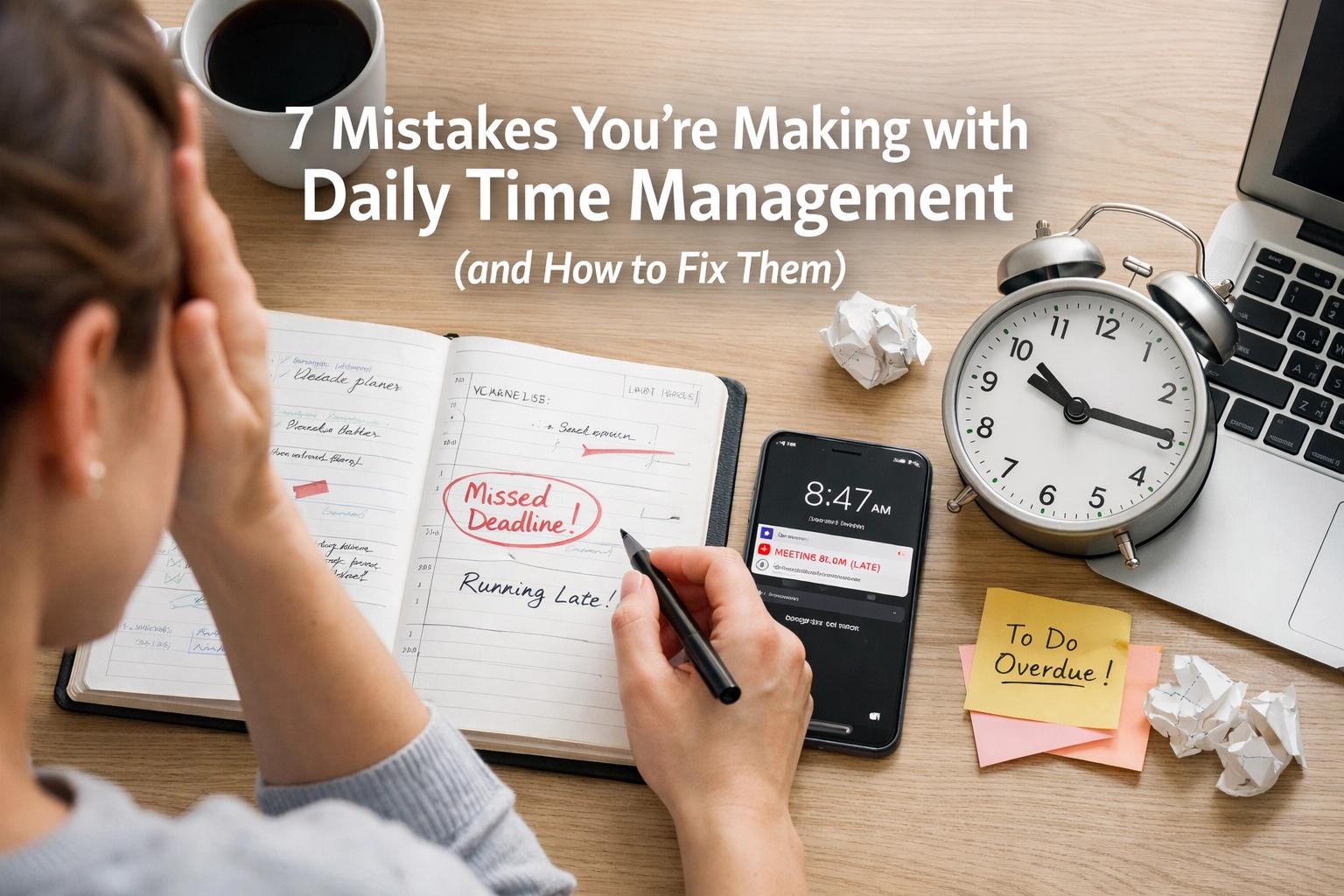
Time is a finite resource, yet many individuals operate as if it were infinite. In the modern world, where the boundaries between professional and personal life often blur, effective time management is no longer a luxury: it is a survival skill. Poor time management leads to more than just missed deadlines; it contributes to chronic stress, reduced sleep quality, and a general sense of being overwhelmed by life’s daily demands.
Understanding where time is lost requires a deep look at daily habits. Most people do not lose hours to a single catastrophic event. Instead, time is bled away in minutes through small, repeatable mistakes. By identifying these common pitfalls and implementing structural changes, it is possible to reclaim hours of the day and improve overall well-being.
1. Operating Without a Tangible To-Do List
One of the most frequent errors in daily management is relying on mental notes. The human brain is excellent at processing information and generating ideas, but it is remarkably poor at storing multiple, competing lists of tasks with precision. When a list is not written down, the mind spends significant energy trying not to forget tasks, leading to a phenomenon known as the Zeigarnik Effect: the tendency to experience intrusive thoughts about an objective that was once started but remains incomplete.
The Science of Open Loops
Every unwritten task is an “open loop” in the psyche. These loops cause cognitive drag, making it harder to focus on the task at hand. When a person finally sits down to work without a list, they often waste the first twenty minutes simply trying to decide where to start. This decision fatigue depletes willpower before the actual work begins.
The Fix: The Night-Before Strategy
The most effective way to combat this is to create a list before the day begins. Preparing a list the previous evening allows the subconscious to process the next day’s requirements during sleep.
- Write everything down: Transfer every task from the mind to paper or a digital tool.
- Use the A-F Coding System: Assign a letter to each task. “A” tasks are critical and have consequences if not completed. “F” tasks are optional or can be delegated.
- Keep it accessible: Use tools to ensure the plan stays visible. For those who reflect or plan late at night, utilizing a bookmark light can help in documenting thoughts without the harsh glare of overhead lights.

2. Pursuing Action Without Clear Goals
Being “busy” is often mistaken for being “productive.” Without clear, long-term goals, daily tasks become a series of reactive movements rather than proactive steps toward a destination. If an individual does not know what they are trying to achieve in a six-month or one-year timeframe, they cannot accurately judge which daily tasks are worth their time.
The Reactive Trap
In the absence of goals, the loudest or most recent demand usually wins. This results in a day spent answering emails, attending unnecessary meetings, or cleaning a workspace rather than completing high-impact projects. This lack of direction eventually leads to burnout, as there is no sense of progress to reward the effort expended.
The Fix: The SMART Framework
To fix this, every daily task should ideally link back to a broader objective. Utilizing the SMART goal framework: Specific, Measurable, Achievable, Relevant, and Time-bound: ensures that goals are grounded in reality.
- Define the “Why”: Before adding a recurring task to a schedule, ask if it serves a long-term goal.
- The Power of Three: Identify the three most important things that must happen today to move toward a larger goal. Focus on these before anything else.
- Discipline and Routine: Establishing a morning routine is vital for goal-oriented living. For those who struggle to start the day on time, an unconventional tool like a flying alarm clock can enforce the discipline needed to get out of bed and begin working on those objectives.
3. The Myth of Multitasking
Many people take pride in their ability to multitask, believing it allows them to accomplish more in less time. However, neuroscientific research consistently shows that the human brain does not truly multitask when it comes to high-level cognitive functions. Instead, it “context switches,” rapidly jumping from one task to another.
The Cost of Task-Switching
Every time focus shifts from a report to an email and back again, there is a “switching cost.” It can take the brain up to 23 minutes to return to a state of deep focus after a distraction. Multitasking can reduce productivity by as much as 40% and significantly increase the rate of errors. It also lowers the IQ of the performer temporarily by an amount equivalent to losing a full night’s sleep.
The Fix: Single-Tasking and Time Blocking
The solution is to embrace single-tasking through a method called time blocking.
- Dedicate blocks of time: Assign 60 to 90 minutes to a single project. During this time, all other tabs, notifications, and distractions are silenced.
- Group similar tasks: Batch “shallow work” like emails or phone calls into one specific block rather than sprinkling them throughout the day.
- Deep Work sessions: Reserve the hours when energy is highest (usually in the morning) for the most cognitively demanding tasks.

4. Failing to Prioritize Effectively
A common time management mistake is treating all tasks as if they have equal importance. When everything is a priority, nothing is a priority. This often leads to a phenomenon where people spend the majority of their day on low-value activities because they are easier to complete than the high-value, difficult ones.
The Urgent vs. Important Dilemma
The Eisenhower Matrix categorizes tasks into four quadrants: Urgent and Important, Important but Not Urgent, Urgent but Not Important, and Neither. Most people spend their lives in the “Urgent but Not Important” quadrant: responding to notifications or minor requests from others. They neglect the “Important but Not Urgent” quadrant, which includes activities like planning, exercise, and skill-building.
The Fix: The 80/20 Rule
Apply the Pareto Principle: 80% of results come from 20% of activities.
- Identify the 20%: Look at a list of ten items. Two of those items will likely yield more value than the other eight combined. Start with those.
- Minimize trivial tasks: Stop wasting time on repetitive, low-value searches or chores. For example, using a wireless key finder can save the cumulative hours spent looking for misplaced items over a year, allowing that time to be redirected toward higher-priority work.
- Learn to delegate: If a task is not in the top 20% and someone else can do it, delegate it.
5. Overloading the Daily Schedule
There is a psychological tendency called the “Planning Fallacy,” where individuals underestimate how long a task will take and overestimate their future productivity. This leads to a packed calendar with no room for error. When the first task of the day runs late: which it almost always does: the entire schedule collapses, creating a domino effect of stress.
Parkinson’s Law
Parkinson’s Law states that “work expands so as to fill the time available for its completion.” When a schedule is overloaded, the quality of work often suffers because the individual is rushing. Conversely, if no time limits are set, a simple task can take all day.
The Fix: Buffers and Environmental Organization
A realistic schedule must account for the friction of daily life.
- The 50% Rule: Estimate how long a task will take and add 50% more time as a buffer.
- Schedule “White Space”: Leave at least one hour of the day completely unassigned to handle emergencies or unexpected opportunities.
- Physical Clarity: A cluttered environment often leads to a cluttered mind, making tasks take longer. Organizing the physical workspace with tools like a 360-degree rotating cosmetic box or desk organizers can streamline daily routines and reduce the time spent searching for supplies.

6. Neglecting the Need for Physical and Mental Breaks
In a high-pressure environment, taking a break can feel like a waste of time. However, the human brain operates on ultradian rhythms: 90-minute cycles of high-frequency brain activity followed by lower-frequency periods. Pushing through these low-frequency periods without a break results in diminishing returns.
The Impact of Decision Fatigue
The more decisions a person makes, the lower the quality of subsequent decisions becomes. By mid-afternoon, a person who hasn’t taken a break is more likely to make mistakes, succumb to distractions, or choose the path of least resistance.
The Fix: Scheduled Recovery
Rest is not the absence of work; it is the preparation for it.
- The Pomodoro Technique: Work for 25 minutes, then take a 5-minute break. After four cycles, take a longer break.
- Change the Scenery: A break is most effective when it involves a change in environment. Leaving the desk and stepping outside can reset the nervous system. Carrying a portable folding mat allows for a quick, clean place to sit in a park or green space during a midday recharge.
- Focus on Sleep: Time management starts with the night before. Ensuring high-quality rest through proper ergonomics, such as using a dedicated sleep pad or pillow, ensures the brain is sharp enough to manage time effectively the next day.
7. Falling Victim to Digital and Environmental Distractions
Distractions are the greatest enemy of a well-managed day. In the digital age, notifications are designed to be addictive, triggering a dopamine response that pulls the mind away from deep work. Beyond the digital realm, environmental distractions: clutter, noise, or interruptions from others: can be equally damaging.
The Biology of Distraction
The brain is wired to notice changes in the environment as a survival mechanism. A ping on a phone or someone walking past a desk automatically triggers an orientation response. While it takes a second to look away, it takes much longer for the cognitive momentum to rebuild.
The Fix: Environment Design
Rather than relying on willpower, it is more effective to design an environment where distraction is difficult.
- Digital Hygiene: Turn off all non-essential notifications. Place the phone in another room during deep work sessions.
- Visual Cues: Use “Do Not Disturb” signals if working in a shared space.
- Environmental Maintenance: Small annoyances can become major distractions. Even something as simple as pilling on a favorite sweater can be a nagging distraction to someone sensitive to their environment. Keeping tools like a hair ball trimmer nearby to maintain one’s professional appearance and comfort can eliminate these minor cognitive “itches.”

Effective time management is not about squeezing every second of productivity out of the day. It is about creating a system that allows for focused work, meaningful progress, and necessary rest. By avoiding these seven common mistakes: lacking a list, working without goals, multitasking, failing to prioritize, over-scheduling, skipping breaks, and allowing distractions: any individual can transform their daily experience from one of chaos to one of intentionality.

