
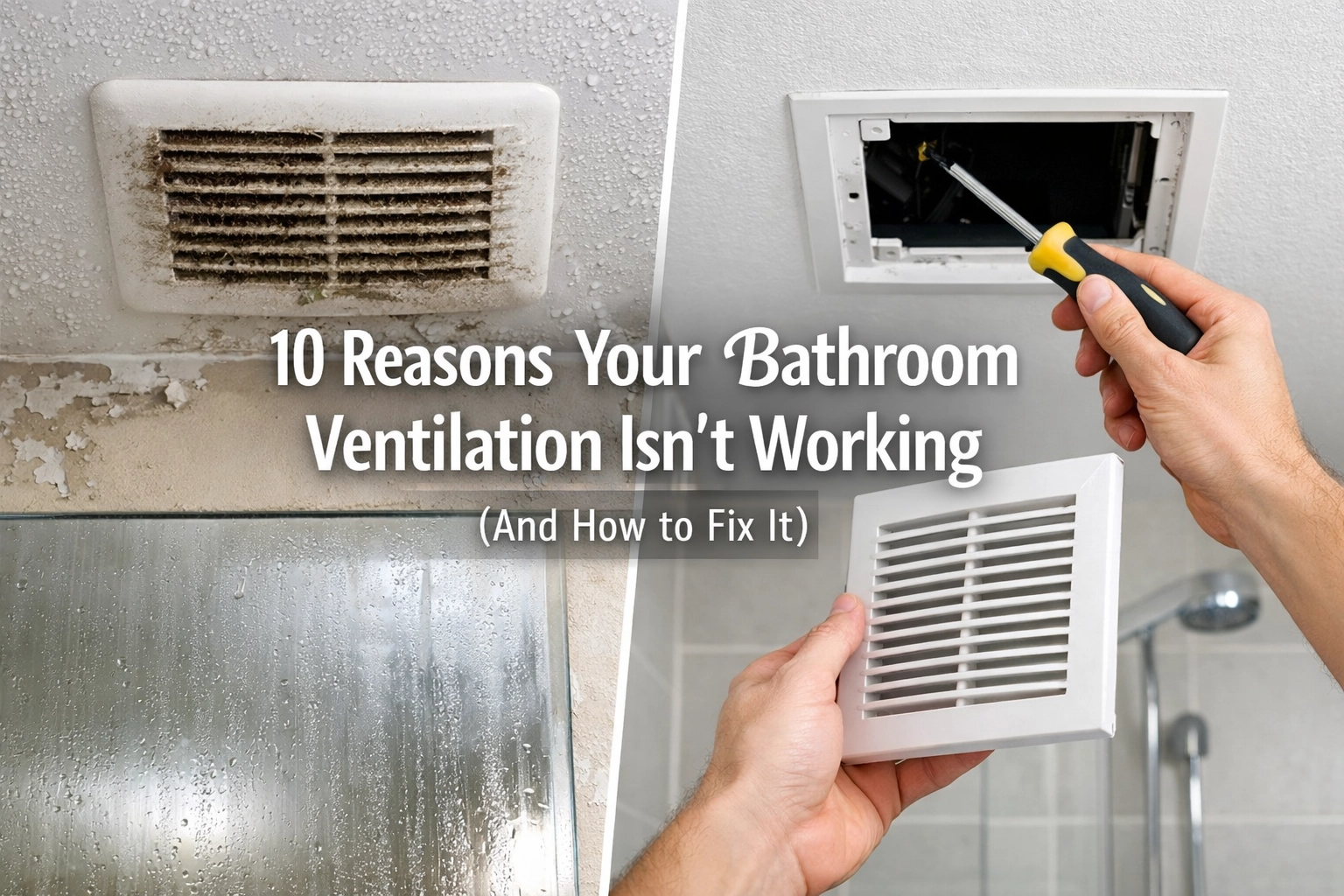
A bathroom exhaust fan is one of the most hardworking yet overlooked components of a home’s mechanical system. Its primary function is to remove moisture-laden air, preventing the growth of mold and mildew while protecting the structural integrity of the walls, ceiling, and cabinetry. When a ventilation system fails to perform, the consequences range from peeling wallpaper and foggy mirrors to serious respiratory issues caused by mold spores.
Identifying why a bathroom fan is underperforming requires a systematic approach to troubleshooting. From mechanical failures to airflow physics, several factors can prevent a fan from doing its job. This guide explores the ten most common reasons for bathroom ventilation failure and provides practical solutions for each.
1. The Fan Is Undersized for the Room
The effectiveness of a bathroom fan is measured in Cubic Feet per Minute (CFM). This rating indicates the volume of air the fan can move in sixty seconds. A frequent mistake in home construction or renovation is installing a fan that lacks the power to clear a specific square footage.
According to standard building guidelines, a bathroom requires at least 1 CFM for every square foot of floor space. For example, an 80-square-foot bathroom needs an 80 CFM fan. If the bathroom features high ceilings (over 8 feet) or a localized “steam shower,” the CFM requirements increase significantly.
How to Fix It
Homeowners should calculate the square footage of the bathroom by multiplying the length by the width. If the existing fan has a lower CFM than the square footage, it should be replaced with a more powerful unit. For larger bathrooms, or those with separate water closets, installing two smaller fans or one high-capacity inline fan may be necessary to ensure adequate air exchange.
2. Accumulation of Dust and Debris
Even the most powerful fan will fail if the intake grille or the internal motor is choked with dust. Over time, the static electricity generated by the fan motor attracts lint, hairspray residue, and household dust. This creates a thick mat that blocks the slats of the cover and weighs down the fan blades.
When the blades are heavy with debris, the motor must work harder, leading to overheating and reduced RPMs (revolutions per minute). Furthermore, the blockage physically restricts the volume of air that can pass through the unit into the ductwork.

How to Fix It
A regular cleaning schedule is essential. The plastic cover (grille) should be removed and washed with warm, soapy water. While the cover is off, use a vacuum with a brush attachment to clear the fan blades and the interior of the housing. For stubborn, greasy buildup common in bathrooms where aerosols are frequently used, a damp microfiber cloth can be used to wipe the blades. Ensure the power is turned off at the circuit breaker before performing any internal cleaning.
3. Excessive Duct Length and Bends
Airflow follows the path of least resistance. In a perfect scenario, a bathroom fan would vent directly through a short, straight pipe to the outside. However, architectural constraints often lead to long duct runs with multiple “elbows” or 90-degree turns.
Every bend in the ductwork adds “equivalent feet” to the total run, creating static pressure that the fan motor must overcome. If a duct is 20 feet long and has three 90-degree turns, the fan might be struggling against the resistance of a 50-foot straight pipe. This drastically reduces the actual CFM delivered at the grille.
How to Fix It
Inspect the ductwork in the attic or crawlspace. If possible, reroute the duct to create the shortest, straightest path to an exterior wall or the roof. Replacing flexible, corrugated “slinky” ducting with smooth-walled rigid metal ducting can also significantly improve airflow, as smooth walls create far less friction.
4. Venting Into the Attic or Wall Cavity
One of the most common and damaging installation errors is venting the bathroom fan directly into the attic, a soffit, or a wall cavity rather than to the outdoors. While the fan may seem to be working because it is pulling air out of the bathroom, the moisture is simply being relocated.
When warm, moist air is dumped into a cool attic, it condenses on the underside of the roof sheathing and in the insulation. This leads to wood rot, ruined insulation, and massive colonies of black mold that can eventually migrate back into the living spaces of the home.
How to Fix It
Homeowners must ensure that the ductwork terminates at a dedicated roof cap or wall vent. It is not sufficient to simply point the duct toward a soffit vent or a ridge vent; the moisture will often “loop” back into the attic. A professional-grade vent termination with a flapper should be installed on the exterior of the house to ensure the air is fully expelled.
5. Condensation in Uninsulated Ducts
In colder climates, the temperature difference between the air inside the duct and the air in the attic can cause a major problem. As the warm, moist air from a hot shower travels through a cold duct, it reaches its dew point and turns back into liquid water.
This water can pool in low spots of the ductwork, eventually sagging the pipe or even leaking back through the fan housing and dripping onto the bathroom floor. This is often mistaken for a roof leak, but it is actually a ventilation failure.

How to Fix It
All ductwork running through unheated spaces (like an attic or crawlspace) should be insulated. This can be achieved by using pre-insulated flexible ducting or by wrapping rigid metal ducts in fiberglass sleeve insulation. By keeping the air inside the duct warm until it exits the house, the moisture remains in a gaseous state and is successfully exhausted.
6. Blocked or Damaged Exterior Dampers
The point where the air leaves the house is protected by an exterior vent cap, usually featuring a “flapper” or a set of louvers. These dampers are designed to open when the fan is on and close when it is off to prevent pests and cold air from entering the home.
However, these dampers can become stuck. Common culprits include bird nests, bee hives, or a buildup of lint. In some cases, layers of exterior paint can accidentally seal the louvers shut. If the damper cannot open, the air has nowhere to go, and the fan will simply spin without moving any air.
How to Fix It
Examine the exterior vent cap from a ladder. Manually check if the flapper moves freely. Remove any obstructions such as bird nests or debris. If the vent is damaged or the plastic has become brittle from UV exposure, replace the exterior cap with a high-quality metal version.
7. Inadequate Make-Up Air
For a fan to exhaust air out of a room, new air must be able to enter the room to take its place. This is known as “make-up air.” In modern, energy-efficient homes that are built very “tight,” a bathroom can become a vacuum if the door is closed tightly.
If there is no gap under the bathroom door, the fan will struggle to pull air against the negative pressure of the room. This results in the fan making a loud, strained noise while failing to remove any steam.
How to Fix It
The standard solution is to ensure there is at least a 1/2-inch to 3/4-inch gap between the bottom of the bathroom door and the flooring. This allows air from the rest of the house to be drawn into the bathroom while the fan is running. In cases where a large gap is not desired for aesthetic or privacy reasons, a louvered door or a dedicated through-wall air transfer grille can be installed.
8. Failing Motor or Worn Bearings
Bathroom fan motors have a finite lifespan, typically ranging from 10 to 20 years depending on the quality of the unit and how often it is used. As the motor ages, the bearings can wear out, or the windings can begin to fail.
A primary sign of a failing motor is a change in sound. A fan that has become excessively noisy, vibrating, or making a high-pitched grinding sound is likely suffering from mechanical wear. Conversely, a fan that hums but doesn’t spin often has a seized motor or a failed capacitor.
How to Fix It
If the motor is failing, it is often more cost-effective to replace the entire fan assembly. However, for many popular brands, “motor kits” are available that allow for the replacement of the internal components without having to tear out the housing from the ceiling. Replacing a motor is a straightforward DIY task that involves unplugging the old motor and snapping the new one into place.
9. Improper Vertical or Horizontal Placement
The placement of the fan within the bathroom significantly affects its efficiency. If a fan is placed in a corner far away from the shower or bathtub, the steam must travel across the entire room before being exhausted. During this travel time, the moisture has ample opportunity to condense on cold mirrors, walls, and windows.
Furthermore, if the fan is placed directly above a heat source, it may fight against the natural convection currents of the room, leading to inefficient clearing of the air.
How to Fix It
Ideally, the fan should be located as close to the primary source of moisture (the shower) as possible. If the shower is enclosed, the fan should be rated for “wet locations” and installed directly inside the shower zone, protected by a GFCI (Ground Fault Circuit Interrupter) circuit. For more information on home layout and technical specifications, readers can explore the site resources for broader home maintenance guides.
10. Stuck Internal Backdraft Damper
In addition to the exterior vent cap, most bathroom fans have a small plastic flap where the housing connects to the ductwork. This is called an internal backdraft damper. Its job is to prevent cold air from the duct from blowing back into the bathroom when the fan is off.
During installation, these dampers can sometimes get stuck in the closed position: often due to a screw being driven through the housing into the damper’s path, or because the duct tape used to secure the pipe is interfering with the hinge. If this flap is stuck shut, the fan will be completely unable to push air into the duct.

How to Fix It
To check this, the fan motor assembly usually needs to be lowered from the housing. Look into the exit port where the duct connects. Use a finger to see if the plastic flap moves freely. If it is obstructed by a screw or tape, remove the obstruction. If the flap is broken or warped, it should be replaced or removed (provided the exterior vent has a functioning damper).
Diagnostic Tests for Homeowners
If it is unclear whether the fan is actually moving air, there are two simple tests that can be performed without specialized tools.
The Tissue Test
Take a single square of toilet paper or a thin tissue and hold it up to the fan grille while the fan is running. If the fan is working correctly, the suction should be strong enough to hold the tissue against the grille. If the tissue falls, the fan is either not moving enough air or there is a blockage in the system.
The Mirror Fog Test
If the fan is correctly sized and functioning, the bathroom mirror should begin to clear within 5 to 10 minutes after a shower has ended. If the mirror remains foggy for 30 minutes or more, or if water is dripping down the walls, the ventilation system is insufficient for the volume of moisture being produced.

Maintaining the System for the Long Term
Once the primary issues are fixed, maintaining the system will prevent future failures. A clean, well-lubricated, and correctly vented fan can save thousands of dollars in mold remediation costs.
- Quarterly Cleaning: Vacuum the grille and motor every three months.
- Check the Exterior: Once a year, use a ladder to check the exterior vent for nests or debris.
- Monitor Humidity: In very humid climates, consider installing a humidity-sensing switch. These switches automatically turn the fan on when moisture levels reach a certain threshold and turn it off once the air is dry, removing the human error of forgetting to flip the switch.
- Check the Attic: Periodically inspect the attic for signs of moisture or disconnected ducts. Even a small gap in the ductwork can lead to significant attic moisture over time.
For those interested in organized home maintenance and educational resources on household management, visiting the post archives can provide further insights into keeping a home in top condition.

Understanding the mechanics of air movement is the first step in solving bathroom moisture problems. By addressing sizing, blockages, and ductwork integrity, homeowners can ensure their bathrooms remain dry, healthy, and free of structural damage. Proper ventilation is not just about comfort; it is a fundamental requirement for a durable and safe home environment.

