
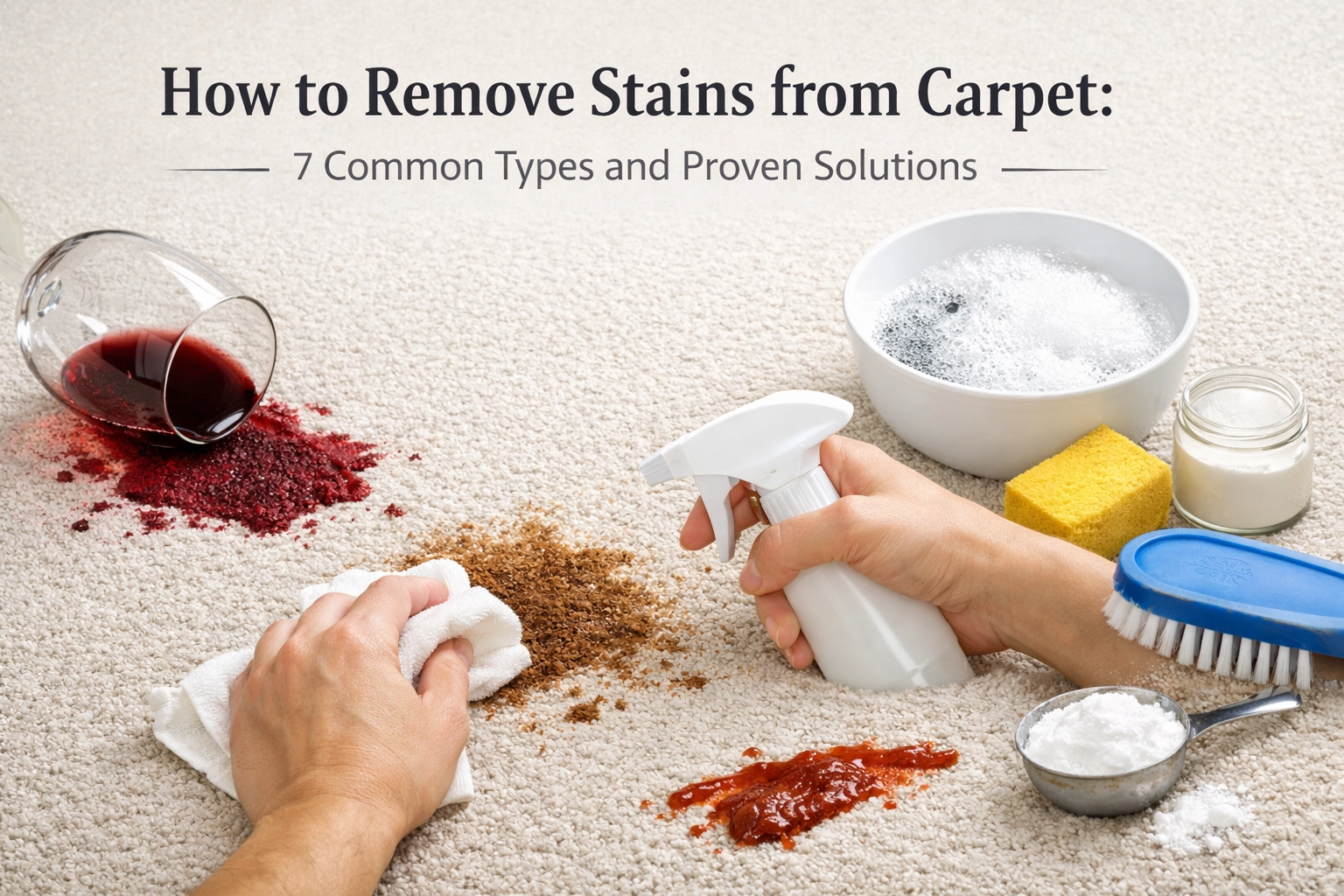
Carpet stains happen. Whether it’s a knocked-over glass of wine, a pet accident, or tracked-in mud, most homeowners will face the challenge of removing something stubborn from their carpets at some point. The good news is that most common stains can be tackled successfully at home with the right approach and materials.
The key to effective stain removal lies in two factors: identifying the type of stain and applying the appropriate cleaning method. Different stains require different solutions because of their chemical composition. Oil-based stains need different treatment than water-based ones, and organic materials like blood or pet urine respond best to enzymatic cleaners.
This guide covers seven of the most common carpet stains and provides proven, step-by-step methods for removing them. Each section includes specific products and techniques that work for that particular stain type.
The Golden Rule: Blot, Don’t Rub
Before diving into specific stain types, understanding the fundamental technique is essential. The single most important rule for treating any carpet stain is to blot instead of scrub.
Blotting works by using gentle pressure to absorb liquid upward out of the carpet fibers. This wicking action pulls the stain toward the cleaning cloth without spreading it or pushing it deeper. Scrubbing or rubbing, on the other hand, forces the stain deeper into the carpet backing and can damage the fibers themselves, creating a worn or fuzzy appearance even after the stain is gone.

To blot properly:
- Use a clean, white cloth or paper towels
- Press down firmly but gently on the stained area
- Lift the cloth and check for stain transfer
- Move to a clean section of cloth and repeat
- Continue until no more stain transfers to the cloth
Working from the outside edges of the stain toward the center also prevents spreading the affected area.
1. Pet Urine and Organic Stains
Pet accidents present a dual challenge: visible staining and persistent odor. Standard cleaners may remove the visible mark but leave behind organic molecules that continue to smell, especially in humid conditions or when the carpet gets wet again.
Solution: Enzymatic cleaners
Enzymatic cleaners contain live bacteria or enzymes that literally digest organic matter. They break down the proteins and compounds in urine, feces, or vomit at a molecular level, eliminating both the stain and the odor source.
Steps:
- Blot up as much liquid as possible with paper towels
- Rinse the area with cold water and blot again
- Apply enzymatic cleaner liberally to the affected area
- Allow it to sit for the time specified on the product label (typically 10-15 minutes)
- Blot dry with clean towels
- Allow the area to air dry completely
For older stains that have already dried, saturate the area more thoroughly and let the enzymatic cleaner work longer. Some pet stains may require multiple treatments, especially if the urine has penetrated into the carpet padding.
2. Ink Stains
Ink stains from pens, markers, or printer cartridges can look intimidating, but they’re surprisingly treatable. Ink is solvent-based, which means it responds to other solvents that can dissolve and lift it from carpet fibers.
Solution: Rubbing alcohol or acetone
Several household solvents can break down ink:
- Isopropyl (rubbing) alcohol – most reliable option
- Acetone (nail polish remover) – effective but test first
- Hairspray – contains alcohol and can work in a pinch
- White vinegar – gentler but may require more applications
Steps:
- Test the chosen solvent on an inconspicuous area of carpet first
- Apply the solvent to a clean white cloth, not directly to the carpet
- Dab the stained area gently, letting the solvent dissolve the ink
- Watch as ink transfers to the cloth
- Move to a clean section of cloth and repeat
- Once the ink is removed, blot with cold water to rinse
- Dry thoroughly with clean towels
The key is patience. Ink removal works through chemical dissolution, not force. Multiple gentle applications work better than aggressive scrubbing.

3. Coffee and Tea Stains
Coffee and tea contain tannins, which are plant compounds that bind strongly to fibers. These stains can set quickly, especially if the beverage contained milk or sugar, but they respond well to acidic cleaners.
Solution: Vinegar and dish soap mixture
The acidity of vinegar breaks down tannins, while dish soap lifts the particles from the carpet.
Steps:
- Blot fresh spills immediately to remove as much liquid as possible
- Mix a cleaning solution in a spray bottle:
- 1 cup warm water
- 1 cup white vinegar
- 1 tablespoon liquid dish soap (Dawn works well)
- Spray the stained area generously
- Let it sit for 5 minutes
- Blot thoroughly with clean towels
- Repeat until the stain no longer transfers to the cloth
- Rinse by spraying with plain water and blotting dry
For stubborn coffee stains with visible discoloration, sprinkle baking soda over the damp area after treatment. Let it sit for several hours or overnight, then vacuum. The baking soda absorbs remaining odor and any residual tannins.
4. Red Wine Stains
Red wine seems like a nightmare stain, but the key is speed and the right oxidizing agent. The pigments in red wine (anthocyanins) can be broken down chemically before they permanently bond to carpet fibers.
Solution: Cold water and oxygen-based cleaner
Cold water dilutes the wine immediately, while oxygen-based cleaners like OxiClean use chemical oxidation to break down the pigment molecules.
Steps:
- Blot immediately to remove excess wine
- Pour cold water over the stain to dilute it (this is one case where generous water application helps)
- Blot the diluted wine
- Mix oxygen-based cleaner according to package directions
- Apply to the stained area
- Let it work for the recommended time (usually 5-10 minutes)
- Blot thoroughly
- Rinse with cold water and blot until dry
Salt is often suggested for wine stains, and it can help absorb fresh spills, but it doesn’t remove the stain itself. Use it as an immediate emergency measure, then follow up with proper treatment.

5. Grease and Oil Stains
Oil-based stains from cooking oil, butter, motor oil, or cosmetics don’t respond to water-based cleaners. The old chemistry rule applies: “like dissolves like.” Oil needs either a surfactant (which bridges oil and water) or another solvent.
Solution: Absorption first, then surfactant
Steps:
- Sprinkle baking soda or cornstarch liberally over the greasy area
- Let it sit for 15-30 minutes to absorb surface oil
- Vacuum thoroughly
- Mix a solution of:
- 2 cups warm water
- 1 tablespoon dish soap (which is a surfactant designed for grease)
- Apply to the remaining stain
- Blot gently, allowing the soap to break down the oil
- Rinse with plain water
- Blot dry
For particularly stubborn grease stains, mineral spirits or rubbing alcohol can work as solvents, but test these first in an inconspicuous area as they can damage some carpet types or remove dye.
6. Blood Stains
Blood stains have a critical rule: never use hot water. Heat causes the proteins in blood to coagulate and permanently bond to carpet fibers. Always use cold water for blood.
Solution: Cold water with soap, then oxygen treatment
Steps:
- Blot fresh blood immediately with cold water
- Mix a solution of:
- Ice cold water
- 1 tablespoon liquid dish soap
- Spray the solution liberally on the stain
- Let it soak for several minutes
- Blot thoroughly
- Repeat until the visible red is gone
- For remaining discoloration, apply oxygen-based cleaner mixed with cold water
- Let it work for 10 minutes
- Blot and rinse with cold water
Blood stains often leave a faint orange or brown shadow even after the red is gone. This is oxidized blood, and oxygen-based cleaners work particularly well on this residue. For very stubborn blood stains, enzymatic cleaners (like those used for pet stains) can also break down the protein molecules.
7. Food and Beverage Stains (Soda, Juice, Kool-Aid)
Brightly colored drinks and foods contain artificial dyes that can leave vibrant stains. These synthetic dyes are usually water-soluble, which is good news: they respond well to simple vinegar solutions.
Solution: Vinegar, dish soap, and water
Steps:
- Blot up as much of the spill as possible
- Mix in a spray bottle:
- 2 cups warm water
- 1/4 cup white vinegar
- 1 tablespoon dish soap
- Spray the stain thoroughly
- Let it soak for 5-10 minutes
- Blot with clean white towels
- Repeat applications until the dye no longer transfers to the cloth
- Rinse by spraying with plain water
- Blot until completely dry
The acidity of vinegar helps break the bond between dye molecules and carpet fibers. Some particularly stubborn dye stains (like from red or purple Kool-Aid) may require multiple treatments over several hours.

General Tips for All Fresh Stains
Regardless of stain type, certain principles apply universally:
Act quickly. Fresh stains are exponentially easier to remove than set stains. The longer a substance sits on carpet, the more time it has to bond with fibers and penetrate into backing and padding.
Start with cold water. For most water-based stains, plain cold water is the safest first step. It dilutes the stain without the risk of setting it (as hot water can do with proteins) or spreading it.
Test cleaning solutions first. Before applying any cleaner to a visible area, test it on a hidden section of carpet, such as inside a closet or under furniture. Wait a few minutes and check for any discoloration or damage.
Use white cloths. Colored towels or rags can transfer dye to wet carpet. White paper towels or white cotton cloths ensure any color transfer visible on the cloth is from the stain, not the cleaning tool.
Rinse thoroughly. Soap residue left in carpet attracts dirt and can make the area look dingy over time. After treating any stain, rinse by blotting with plain water and then dry thoroughly.
Dry completely. Damp carpet can develop mildew or odor. After treating a stain, blot with dry towels until no more moisture transfers. Use fans or open windows to speed drying if needed.
When to Call a Professional
DIY stain removal works remarkably well for fresh, surface-level stains. However, some situations warrant professional help:
Large or saturated areas. If a stain covers more than a few square feet or has soaked through to the padding, professional extraction equipment may be necessary to fully remove it and prevent mold growth.
Old, set-in stains. Stains that have been present for weeks, months, or years may have chemically bonded to carpet fibers or discolored them permanently. Professionals have access to stronger chemicals and specialized techniques that aren’t available to consumers.
Delicate or valuable carpets. Antique rugs, wool carpets, or expensive specialty fibers may require expert cleaning to avoid damage. The cost of professional cleaning is usually less than the cost of replacing a damaged valuable carpet.
Persistent odors. If odor remains after multiple treatments, especially with pet stains, the source may be in the carpet padding or subfloor. Professional services can assess and treat these deeper issues.
Warranty requirements. Some carpet warranties require professional cleaning at specified intervals. Check warranty terms before attempting DIY cleaning on new carpet.
Professional carpet cleaning services typically use methods like hot water extraction (steam cleaning), low-moisture encapsulation, or specialized stain removal treatments that go beyond what’s possible with household products.
Prevention and Maintenance
While knowing how to remove stains is valuable, preventing them in the first place saves time and preserves carpet life:
- Apply carpet protector treatments like Scotchgard after cleaning
- Establish a no-shoes policy indoors
- Use area rugs or carpet runners in high-traffic areas
- Clean up spills immediately, before they set
- Vacuum regularly to prevent dirt from being ground into fibers
- Schedule professional deep cleaning annually
Most carpet stains, when caught early and treated with the right method, can be removed successfully at home. Understanding which type of stain requires which approach: and remembering to blot instead of scrub: makes the difference between a quick cleanup and a permanent mark.

