
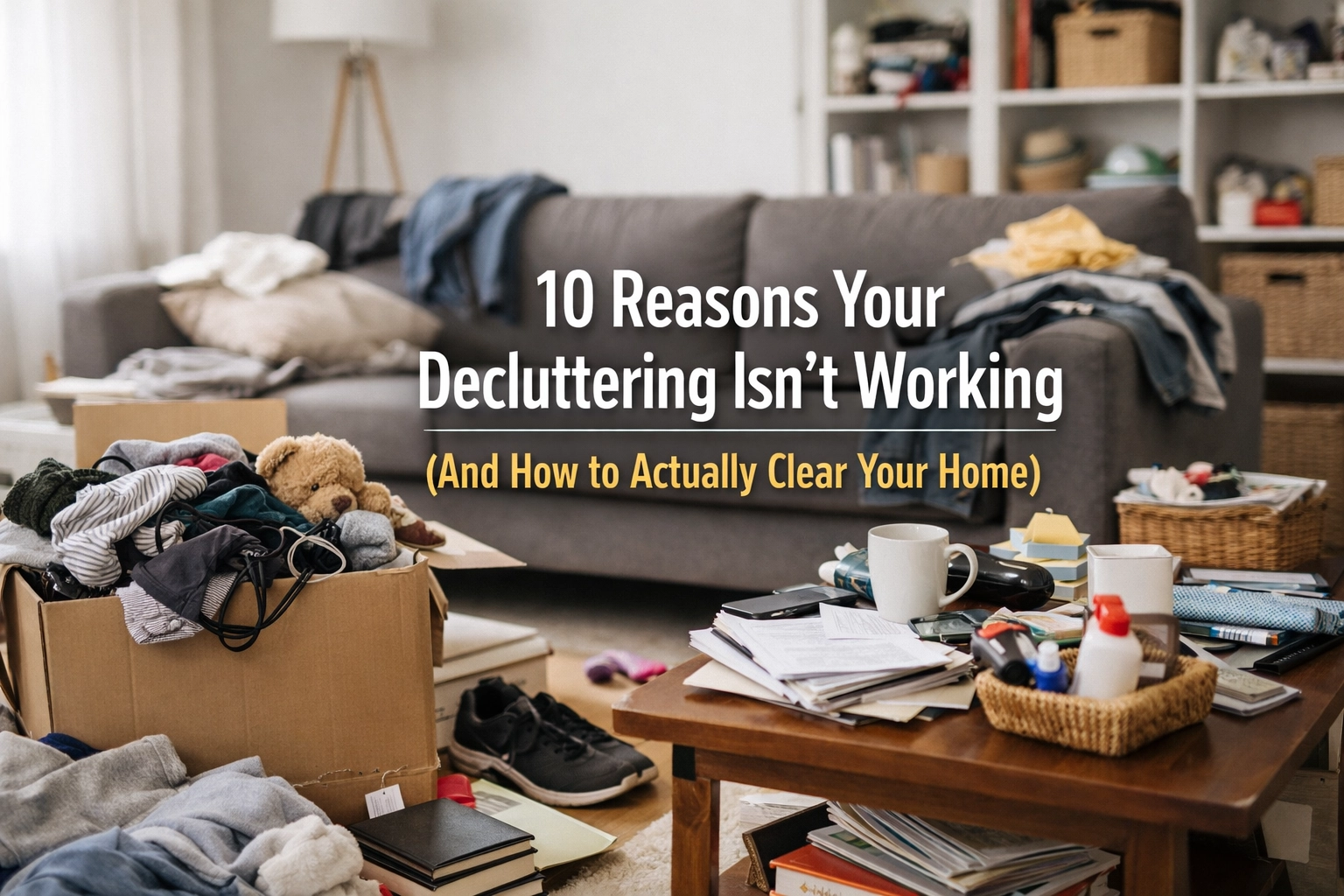
Decluttering projects often start with enthusiasm and end in frustration. Bags of items get shuffled between rooms, organizing supplies pile up unused, and the home looks just as cluttered weeks later. The problem usually isn’t lack of effort: it’s the approach.
Understanding why decluttering attempts fail helps create a more effective strategy. These ten common mistakes derail even the most determined organizing efforts, along with practical solutions that actually work.
Starting Without a Clear Plan
Wandering from room to room, grabbing random items, and making spontaneous decisions rarely produces lasting results. This scattered approach moves clutter around without actually reducing it. Hours pass with little visible progress, leading to burnout before meaningful change happens.
The absence of clear goals creates confusion about what to tackle first. Should the focus be on the overflowing kitchen cabinets, the cluttered bedroom closet, or the basement full of storage boxes? Without direction, energy gets wasted on low-priority areas while major problem zones remain untouched.
The fix: Before touching a single item, define specific goals. Choose one room or area to complete entirely before moving to the next. Establish what “success” looks like for that space: for example, “all clothing fits in the closet with room to spare” or “kitchen counters are clear except for daily-use appliances.”
Write down the plan and set realistic time estimates for each area. A bathroom drawer might take 20 minutes, while an entire garage could require multiple weekends. Breaking the project into defined chunks with clear endpoints provides direction and maintains momentum.

Buying Organizing Products Before Decluttering
Storage containers, baskets, shelf dividers, and drawer organizers promise to solve clutter problems. The impulse to purchase these products before removing unnecessary items creates two issues: the organizers themselves become clutter, and money gets wasted on products that don’t fit the actual needs.
Those beautiful matching bins might not be the right size or shape for the items that remain after decluttering. Purchasing organizers prematurely means guessing at future needs rather than addressing actual requirements.
The fix: Complete the entire decluttering process before buying any organizing supplies. Most homes already contain organizing tools that can be repurposed once belongings get pared down. That unused basket in the linen closet might be perfect for bathroom toiletries. The empty shoe boxes could organize small office supplies.
After decluttering, assess what actually needs organization. Measure spaces and count items before shopping. This approach ensures purchasing only what’s necessary and getting products that genuinely fit the space and belongings.
Attempting Too Much at Once
Deciding to “organize the entire house this weekend” sets up failure. Large-scale projects create overwhelming messes and rarely get completed in the allotted time. When Monday arrives and half the house remains in chaos, discouragement replaces motivation.
The visual impact of an enormous, incomplete project triggers stress rather than satisfaction. Seeing progress requires completing tasks, not starting many simultaneously.
The fix: Scale down dramatically. Instead of tackling an entire room, focus on one drawer, one shelf, or one cabinet. These smaller zones can be completely decluttered and organized in 15-30 minutes, providing immediate satisfaction and visible results.
This incremental approach maintains energy and motivation. Completing five small areas in a week produces more actual progress than starting ten large areas and finishing none. The cumulative effect of many small victories creates significant transformation over time.

Pulling Everything Out Simultaneously
The advice to “empty everything onto the floor” works for some situations but often backfires. Creating a massive pile of belongings without a realistic timeline for sorting through it all leads to chaos that persists for days or weeks.
Life interrupts these large-scale projects. Phone calls, meal prep, family needs, or simple exhaustion can halt progress, leaving a home in disarray. The resulting mess becomes demoralizing and difficult to resume.
The fix: Work methodically through one section at a time, removing only what can be realistically sorted and returned within the current work session. If decluttering a bookshelf, remove and process one shelf before moving to the next. For a closet, handle one category of clothing at a time: shirts, then pants, then accessories.
This controlled approach ensures each work session ends with visible improvement rather than increased chaos. The space always remains functional, even if the project takes multiple sessions to complete.
Relocating Clutter Instead of Removing It
Moving items from the living room to the basement, from counters to drawers, or from one closet to another creates an illusion of decluttering without actual reduction. The home’s visible areas might look better temporarily, but the overall volume of belongings remains unchanged.
This shuffling strategy doesn’t free up space or reduce the mental burden of managing possessions. Hidden clutter still requires storage, still needs occasional sorting, and still weighs on the mind even when out of sight.
The fix: Establish three clear categories for items leaving their current location: donate, sell, or trash. Commit to physically removing these items from the home promptly. Donation bags should go to charity within 48 hours. Items to sell should be listed immediately or added to a garage sale box with a firm date set.
Create accountability by scheduling donation drop-offs in advance. Tell a friend about the commitment to follow through. The goal isn’t moving things around: it’s actually reducing what the home contains.

Making Excuses to Keep Unnecessary Items
Common justifications prevent letting go of items that no longer serve any purpose. “I might need this someday” keeps rarely-used items occupying valuable space. “I paid good money for this” turns past spending decisions into reasons to store unused possessions indefinitely. “It was a gift” creates guilt about releasing items that don’t fit current needs or preferences.
These mental barriers accumulate over time, filling homes with belongings attached to theoretical future scenarios, past financial decisions, or others’ expectations rather than present reality.
The fix: Challenge each justification with honest questions. “Might need someday” requires asking when this item was last used and whether it could be easily obtained if that rare scenario occurs. Past cost cannot be recovered by storing an unused item: the money is already spent regardless.
Gifts given with love were meant to bring joy, not guilt. Keeping unwanted gifts doesn’t honor the giver if those items create stress or take up needed space. The memory of someone’s thoughtfulness exists independently of the physical object.
Set specific parameters: if an item hasn’t been used in 12 months (excluding seasonal items), hasn’t been thought about in six months, or doesn’t fit the current lifestyle, it goes.
Delaying Decisions With “Maybe” Piles
Creating a “maybe” pile for items that seem too difficult to categorize immediately slows progress significantly. These indecision zones grow large and require additional sorting sessions, effectively doubling the work.
The “maybe” pile becomes a holding pattern that prevents closure. Items get shuffled back into storage without real evaluation, and the decluttering effort produces minimal actual change.
The fix: Make immediate decisions when handling each item. Establish clear criteria before starting: the item gets kept only if it’s regularly used, serves a specific current purpose, or brings genuine joy. Everything else gets donated, sold, or discarded.
For truly difficult decisions, set a firm limit: a “maybe” box can hold no more than ten items. These get revisited at the end of the session, not indefinitely postponed. The constraint forces more decisive thinking about what really matters.
If deciding still feels impossible, box the uncertain items with a date six months away. If those items haven’t been needed or thought about when that date arrives, they can go without additional deliberation.
Handling Items Multiple Times
Picking up an item, examining it, setting it down, then picking it up again later wastes time and energy. This repeated handling happens when decisions aren’t made immediately or when items lack designated destinations.
Each additional touch of an object extends the decluttering process unnecessarily. Multiple handling also creates fatigue, making later decisions more difficult as mental energy depletes.
The fix: Implement a one-touch rule. When picking up an item, decide its fate immediately and take action. If it’s being donated, it goes directly into the donation box. If it’s being kept, it goes immediately to its storage location.
Set up stations before beginning: a donation box, a trash bag, and a sell pile. Having these destinations ready prevents the need to set items down for later categorization. Each object moves directly from its current location to its new destination in a single motion.
This approach requires more initial mental effort but dramatically speeds up the overall process and reduces decision fatigue.

Ignoring the Underlying Causes
Decluttering without examining why clutter accumulates won’t create lasting change. The same patterns that created the current situation will recreate it after organizing efforts end. Within months, spaces fill up again, requiring another overwhelming decluttering project.
Shopping habits, household routines, storage limitations, or emotional attachments to possessions drive clutter accumulation. Without addressing these root causes, decluttering becomes a temporary fix rather than a permanent solution.
The fix: Before starting the physical decluttering process, identify specific behaviors or circumstances that contributed to the current situation. Does online shopping create a constant influx of packages? Do household members lack systems for managing daily items like mail, keys, or shoes? Is the home genuinely too small for the household’s needs?
For each identified cause, develop a concrete plan to address it. If impulse shopping is the issue, implement a 48-hour waiting period before purchases. If mail piles up, create a daily routine for processing it. If the home lacks adequate storage, consider whether some possessions could be relocated to serve others better.
These systemic changes prevent clutter from regenerating after the hard work of clearing spaces.
Skipping Self-Reflection About Possessions
Many items get kept for reasons unrelated to their practical utility. Objects can represent aspirational identities, past versions of self, or emotional connections to people and experiences. Without examining these deeper attachments, decluttering becomes a superficial exercise that doesn’t address why letting go feels difficult.
The home fills with items representing who someone hopes to become: craft supplies for hobbies never started, athletic equipment for workouts never done, or professional clothes for a career no longer pursued. These aspirational possessions take up space while generating guilt about unfulfilled intentions.
The fix: Before handling items in a category, spend a few minutes considering what those belongings represent. Are the kitchen gadgets kept because of genuine cooking interests or because of an image of being the type of person who makes elaborate meals?
Separate the memory or idea from the physical object. Photographs can preserve memories without keeping every item associated with past experiences. Current identity and future goals matter more than past intentions. The person someone actually is deserves a home that supports their real life, not an imaginary one.
For sentimental items, select a small number of truly meaningful pieces to keep and display. Everything else can go while the memories remain intact.
Effective decluttering requires more than good intentions and free time. It demands a strategic approach that addresses decision-making processes, emotional attachments, and systemic causes of clutter. By avoiding these common mistakes and implementing practical solutions, homes can be transformed from cluttered and stressful to organized and peaceful. The key lies in working systematically, making decisive choices, and creating habits that prevent clutter from returning.

